


How to Safely Use Laundry Bleach


Bestsellers for Bleach
Bleach is actually two different products sold under the same name. Chlorine bleach whitens, disinfects, and strips dye. Oxygen bleach lifts stains from colors without destroying them. Using the wrong one is the most common laundry bleach mistake.
Chlorine bleach vs. oxygen bleach
 Chlorine bleach (Clorox Regular, Signature SELECT Bleach) contains 5 to 8.25% sodium hypochlorite. It whitens whites, removes stains, and kills germs. It also strips dye from most colored fabrics, which is why it's only appropriate for whites and for disinfection.
Oxygen bleach (Clorox 2, Clorox ColorLoad, OxiClean) uses hydrogen peroxide or sodium percarbonate. Powder versions dissolve into hydrogen peroxide in water. Oxygen bleach is safe for most colors and gentler on fibers. Its whitening power is moderate, not strong.
If a label says "color-safe bleach" or "non-chlorine bleach," it's oxygen bleach. Same chemistry, different marketing terms.
Can you use bleach on colored clothes?
 No, chlorine bleach will strip the color. Dilution doesn't change that. Diluted chlorine bleach takes longer to destroy the dye, but the damage is still happening.
For brightening, whitening, or stain removal on colored clothes, use oxygen bleach. Clorox 2, OxiClean, and Clorox ColorLoad all do this. They use hydrogen peroxide rather than sodium hypochlorite, which lifts stains without attacking most fabric dyes.
The one exception: the colorfastness test
Some colored fabrics are dyed with chlorine-resistant pigments and will survive a chlorine bleach wash. Clorox publishes a specific test to find out:
- Mix 1/4 cup water with 2 teaspoons of Clorox Disinfecting Bleach.
Apply a drop to a hidden area (inside hem, pocket lining, inside seam).
Wait 1 minute.
Rinse and blot dry.
If the color doesn't change, the fabric passes. Test each color separately on multi-colored items. Most colored fabrics will fail this test. It's a tool for specific items, not a general workaround.
Does bleach actually kill germs in laundry?
 Yes, at the right concentration. The CDC recommends unscented household bleach with 5 to 9% sodium hypochlorite for disinfection. A 2007 study found that washing with detergent alone reduced viruses in laundry by 92 to 99%, and adding sodium hypochlorite brought that to at least 99.99%.
Bleach is effective against common laundry-relevant pathogens: bacteria like Staph, Salmonella, and E. coli; fungi; and most viruses including influenza and coronaviruses.
Two things determine whether it actually works:
Concentration. The product has to be in the 5 to 9% range. Regular Clorox Disinfecting Bleach (7.5%) qualifies. Clorox's concentrated and germicidal versions (8.25%) also qualify.
Contact time. The CDC standard is at least one minute of contact at proper dilution. A normal laundry cycle provides far more than that.
The splash-less problem
Splash-less bleach is not always equivalent to regular bleach, and the label difference is easy to miss.
Clorox sells two kinds of splash-less product:
Clorox No-Splash Disinfecting Bleach (unscented, around 4.5% sodium hypochlorite) is EPA-registered and disinfects.
Clorox Splash-Less Bleach in scented varieties (Clean Linen, Fresh Meadow) has much lower sodium hypochlorite, around 1 to 2%. Its back label reads: "Not for sanitization or disinfection."
If you're buying bleach to sanitize laundry during illness, check the back label. A product that says "not for sanitization or disinfection" will not disinfect, no matter how much you use. For sanitizing, grab regular Clorox Disinfecting Bleach.
Sanitizing colored laundry
Chlorine bleach destroys colored fabric, and standard oxygen bleach isn't EPA-registered as a sanitizer. For a sick person's colored sheets or towels, Clorox Laundry Sanitizer is the purpose-built product: no bleach, color-safe, EPA-registered, works in cold water. Its active ingredient is a quaternary ammonium compound rather than sodium hypochlorite.
How to use bleach in laundry
How much
Purpose | Standard washer | HE washer |
|---|---|---|
Sanitizing | 1/2 cup | 1/4 cup |
Whitening or normal soil | 1/3 cup | Fill dispenser to max line |
Heavy soil | 2/3 cup | Fill dispenser to max line |
More than this doesn't help. Excess bleach weakens fibers and eventually yellows whites.
When to add it
If your washer has a bleach dispenser, pour the bleach in before starting the cycle. The machine releases it at the right time. Don't overfill past the max-fill line; that causes premature dispensing, which puts undiluted bleach on fabric.
If your washer has no dispenser, dilute the measured bleach in a quart of water. Start the cycle, let it fill, then add the diluted bleach about five minutes in. The delay lets detergent enzymes work first.
Never pour bleach directly on dry fabric. Undiluted sodium hypochlorite at 7 to 8% concentration permanently discolors fibers on contact and weakens them over time.
Water temperature
Bleach works at any temperature. Hot water kills germs on its own and helps with heavily soiled loads. For sanitization alone, warm water is fine. Very hot water actually degrades sodium hypochlorite faster, so you don't need to crank the dial to maximum.
Fabrics to never bleach
Wool, silk, mohair, leather, and spandex. Also anything labeled "do not bleach" on its care tag.
Why you shouldn't mix bleach with other cleaners
Bleach is a strong oxidizer. The same chemistry that lets it break down stains and kill germs also makes it react aggressively with many other cleaning chemicals. Those reactions can produce harmful fumes, and most household cleaners don't list every ingredient in plain language on the label.
The safe rule: use bleach on its own or with plain laundry detergent. Don't combine it with any other cleaning product, even if you think it would boost the cleaning power. If you've just used another cleaner on a surface, rinse it with water before applying bleach. Work in a ventilated space: open a window or run the laundry room fan.
The common laundry mistake: bleach and OxiClean
OxiClean is an oxygen bleach. Adding it to a chlorine bleach load doesn't double the cleaning power. The two oxidizers neutralize each other, and you end up with less cleaning action than either product alone. Clorox tells customers directly not to combine them. Pick one or the other per load.
Bleach and regular laundry detergent are fine
Standard laundry detergents are formulated to work alongside chlorine bleach. Add the bleach via the dispenser, or five minutes into the cycle if you're adding it manually. The detergents to avoid are ones labeled "do not use with chlorine bleach" on the package. Some plant-based formulas fall into that category.
Storage and shelf life
 Bleach degrades faster than most people realize. Sodium hypochlorite breaks down into salt water over time, and heat and light speed up the process.
Clorox states that unopened bleach is effective for about one year from production. Stored in a hot garage (90°F or higher), it can lose effectiveness in three months. If you need bleach to actually disinfect, it's worth checking how old the bottle is.
Reading the date code. Clorox doesn't print an expiration date. It stamps a production code on the bottle neck: plant code, then the last two digits of the year, then the day of the year (1 to 365). A code containing "22234" means day 234 of 2022 (August 22, 2022). That bottle is effective for about a year from then under normal storage.
Storage conditions. Cool, dry, out of direct sunlight. Original container, tightly closed. Not near a water heater, a dryer, or in a garage that bakes in summer. Away from children and pets.
Diluted bleach solutions. If you mix bleach with water for cleaning, use it that day. Effectiveness drops significantly within 24 hours.
FAQ
Can I use bleach on silk or wool?
No. Both chlorine and oxygen bleach damage protein fibers. Use a detergent designed for delicates.
What's the difference between germicidal bleach and regular Clorox?
Germicidal bleach has higher sodium hypochlorite concentration, usually 8.25%, and carries a broader set of EPA-registered disinfection claims. Regular Clorox Disinfecting Bleach at 7.5% also disinfects and is adequate for home laundry sanitization.
Can I use bleach and OxiClean together?
No. The sodium hypochlorite in bleach and the hydrogen peroxide released by OxiClean neutralize each other and release oxygen gas. You get less cleaning power, not more. Pick one or the other per load.
Can I use vinegar in the same load as bleach?
No. Vinegar and bleach react badly together. If you're running a bleach load, skip the vinegar that time and use it on a different load.
Does bleach expire?
Yes. Most bottles are effective for about a year from production. After that, sodium hypochlorite concentration drops and disinfection claims no longer hold. Old bleach is usually fine for general cleaning but shouldn't be trusted to kill germs.
What do I do if I spill bleach on clothes?
Rinse immediately with cold water. A paste of baking soda and water (2 tablespoons baking soda to 1 tablespoon water) applied for 30 minutes then rinsed out neutralizes any active bleach still on the fabric and stops ongoing damage.
What the paste can't do is bring the color back. Once chlorine bleach has destroyed the dye molecules, the bleached spot is permanent. For small spots on dark fabric, a fabric marker can camouflage the area. For larger spots, the garment is usually lost. On white fabric, the baking soda rinse is often enough on its own.
Is it safe to pour bleach down the drain?
On a municipal sewer, yes. Dilute with plenty of running water. On a septic system, use it sparingly. Normal laundry amounts are tolerable, but pouring out a large volume (like disposing of an old bottle) can kill the bacteria your septic tank relies on. For disposal at that scale, use a household hazardous waste drop-off.
Can I use bleach to clean my washing machine?
Yes. Run an empty cycle with hot water and a cup of regular Clorox Disinfecting Bleach. This clears residue and bacterial buildup. Skip splash-less bleach for this; the concentration is too low to do the job.
Safeway Buying Guide

Cloralen Concentrated - 121 FZ
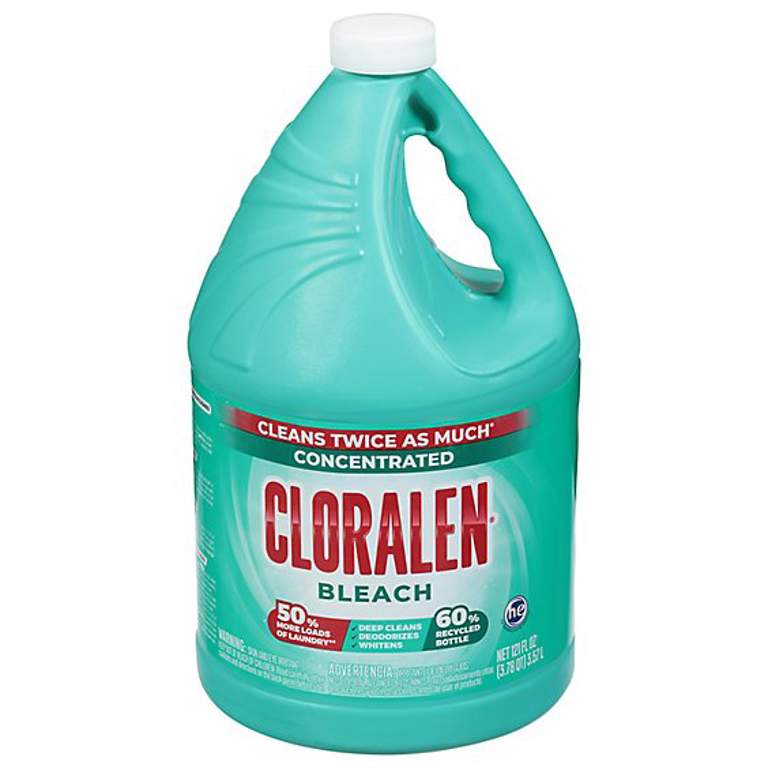



- Cloralen Concentrated is a bleach that cleans twice as much area, whitens, deodorizes and gives 50% more loads of laundry than the regular Cloralen bleach. Additionally, it is formulated for use in standard and HE machines, is made with 60% recycled bottle and can be used for stain removal. With its deep cleaning capabilities it will leave your home sparkling clean!
- Highly concentrated formula that provides powerful cleaning
- Effective in eliminating tough stains and dirt
- Provides a fresh and clean scent after use
- Versatile - can be used on a wide range of surfaces
- Large quantity (121 FZ) ensures long-lasting use
- Simple to use with clear, easy-to-follow instructions
- Users appreciate its affordable price for the value it provides
Clorox Regular Splashless Disinfecting Bleach Bottle - 77 Fl. Oz.

Clorox Regular Splashless Disinfecting Bleach Bottle offers a controlled pour with less spilling and splashing, killing 99.9% of bacteria and viruses for a powerful clean. This bleach liquid whitens, brightens, deodorizes and provides 10X deep cleaning benefits to remove tough stains from white clothing. It is easy to pour and handle, perfect for everyday cleaning in both standard or HE washers. Also, the product is made in the USA of global components.
- Kills 99.9% of germs and bacteria, ensuring a clean and safe environment.
- Splashless design makes it easy and safe to use, reducing the risk of spills and accidents.
- Comes in a convenient 77 Fl. Oz. bottle, providing ample quantity for extensive cleaning.
- Regular variant provides consistent, reliable results with every use.
- Can be used on a variety of surfaces, making it a versatile cleaning solution.
- The product is from Clorox, a trusted brand known for its high-quality cleaning products.
- Easy to use with clear instructions, making it suitable for both home and professional use.
Signature Select Bleach Low Splash Regular - 121 FZ


This product, Signature Select Bleach Low Splash Regular - 121 FZ, is a concentrated cleaner that deodorizes and brightens laundry. It is 100% guaranteed for quality and satisfaction or your money back.
This product has many positive features. It is a concentrated cleaner that effectively deodorizes and brightens laundry for standard and HE washers. It also comes with a 100% money back guarantee, so you can be sure of its quality and satisfaction. Additionally, it comes with helpful instructions for both laundering and cleaning, so you can get the best results from the product. Moreover, it contains safety warnings to ensure that it's used safely.
- Signature Select Bleach offers a low splash feature, making it easier and safer to use without worrying about accidental spills.
- The product comes in a substantial 121 FZ size, providing excellent value for money.
- Users appreciate its regular scent, which is not too overpowering yet effectively masks unpleasant odors.
- It has been praised for its high effectiveness in cleaning and disinfecting surfaces, making it a reliable choice for maintaining hygiene.
- The bleach is also appreciated for its versatility, as it can be used on a wide range of materials and surfaces.
- Customers have noted that the bleach does not leave any residue after use, ensuring a clean and tidy finish.
- Many users have mentioned the product's easy-to-use packaging, which further enhances the overall user experience.


