


Eggs and Cholesterol Why the Advice Changed


Bestsellers for Eggs
For decades, eggs were the villain. The American Heart Association told people to eat no more than three a week, and the yolk's 186 milligrams of cholesterol was treated like a dietary grenade. Then in 2015, the federal nutrition guidelines dropped the cholesterol limit entirely. The AHA now says up to one egg a day is fine for healthy adults.
The honest answer: eggs are fine for most people, potentially problematic for some, and the thing you cook them in probably matters more than the egg itself.
How many eggs you can eat
The major medical organizations agree on the broad strokes. The disagreement is at the edges.
Organization | Healthy adults | High cholesterol or diabetes |
|---|---|---|
American Heart Association (2019) | Up to 1/day (2/day for healthy older adults) | Reduce intake |
Dietary Guidelines for Americans (2020-2025) | No specific limit | No specific limit |
Harvard School of Public Health | Up to 1/day | 3 yolks/week max for diabetics |
Mayo Clinic | 1/day | 3-4/week |
Cleveland Clinic | 1/day (2/day for healthy adults over 65) | 4 yolks/week max |
British Heart Foundation | No specific limit | 3-4/week for familial hypercholesterolaemia |
For everyone outside the at-risk groups, the evidence supports eating eggs without much worry. The groups that should be more careful:
People with high LDL cholesterol. LDL is the "bad" cholesterol that builds up in your arteries. If your LDL is high, the AHA recommends reducing both saturated fat and dietary cholesterol, since together they contribute more to plaque buildup (fatty deposits that narrow your arteries) than either alone. Around 3-4 eggs per week is a typical recommendation.
People with diabetes. Harvard's long-running studies found higher heart disease risk in diabetics who ate one or more eggs per day. The AHA and Harvard both suggest greater caution. Talk to your doctor about your situation.
Hyper-responders. Normally, when you eat more cholesterol, your liver produces less to compensate. About 15-25% of people don't have this feedback loop working well, and their LDL rises meaningfully when they eat eggs. There's no routine test for this. If your LDL is stubbornly high despite other dietary changes, cutting eggs for a month and retesting is a reasonable experiment.
People with familial hypercholesterolaemia (FH, an inherited condition where the body can't clear LDL efficiently). The British Heart Foundation recommends no more than 3-4 eggs per week.
How you cook them
The total cholesterol in an egg is 186 milligrams regardless of cooking method. What changes is cholesterol oxidation: a chemical reaction where heat and air damage the cholesterol molecules and form compounds called oxysterols, which are more likely to contribute to plaque buildup than undamaged cholesterol.
From least to most oxidation: poached, soft-boiled, hard-boiled, fried, scrambled. Scrambling breaks the yolk and exposes all the cholesterol to heat and air simultaneously, producing the most oxidation. Poaching keeps the yolk intact in water.
This doesn't make scrambled eggs dangerous. If you eat eggs daily and want to optimize, poaching and soft-boiling are slightly better choices. But what you cook them in matters more than how. The butter adds saturated fat. The egg doesn't. A 2025 study in the American Journal of Clinical Nutrition tested exactly this: 61 adults each tried three diets for five weeks. The 2-eggs-per-day diet with low saturated fat lowered LDL compared to the control. The no-egg, high-saturated-fat diet did not. Across all three diets, the more saturated fat people ate, the higher their LDL went. Eggs alongside bacon and buttered toast is a different meal than eggs poached with vegetables.
What you're getting per egg
The cholesterol conversation drowns out everything else about eggs. Here's what 72 calories actually gets you.
Protein
One large egg has 6 grams of complete protein, meaning all 9 essential amino acids in proportions the body can use efficiently. Eggs score a perfect 1.0 on the PDCAAS scale (the system used to rate how well your body can use a food's protein), alongside milk and soy protein.
About 60% of the protein is in the white, 40% in the yolk. A 2017 University of Illinois study found whole eggs helped muscle recovery after exercise more than the same amount of protein from egg whites alone. The researchers think the yolk's fats and vitamins help the body use the protein better. It was a small study in young men, so how much this matters over months of training isn't clear.
Choline
This is the nutrient that deserves more attention than cholesterol gets. One yolk has 147 milligrams of choline, about 27% of the daily adequate intake. Eggs are one of the richest commonly eaten sources.
Choline is critical for brain development, liver function, and keeping cells intact. Your body uses it to make acetylcholine (a brain chemical involved in memory and muscle control). During pregnancy, choline is essential for the baby's brain and spinal cord development. About 90% of Americans don't get enough. Two eggs cover over half the daily need. Egg whites have zero choline.
There's a complication. Bacteria in your gut break down some choline into a precursor that your liver converts into TMAO, a compound Cleveland Clinic research has linked to inflammation in blood vessels and plaque buildup. The research hasn't sorted out which effect wins. For most people eating a varied diet, the choline benefits likely outweigh the TMAO concern, but scientists are still working on this.
Vitamins and minerals
Almost everything lives in the yolk.
Nutrient | Per large egg | Why it matters |
|---|---|---|
Vitamin D | ~41 IU | One of few natural food sources, but not enough on its own (600-800 IU daily target) |
Vitamin B12 | 25% daily value | Nerve function and DNA synthesis |
Selenium | 28% daily value | Thyroid and immune function |
Lutein + zeaxanthin | ~252 mcg | Protect against age-related vision loss; better absorbed from eggs than greens because yolk fat helps your body take them in |
Riboflavin (B2) | 15% daily value | Energy metabolism |
Iron | ~0.9 mg | From the yolk |
Remove the yolk and you lose all the fat-soluble vitamins (A, D, E, K, which need fat to be absorbed), all the choline, all the lutein and zeaxanthin, all the iron, and 40% of the protein. What remains is 17 calories of protein and water. Egg whites work as an additional protein source, but treating them as a substitute for whole eggs means giving up most of what makes eggs nutritionally worth eating.
If your doctor has told you to limit yolks because of high cholesterol, liquid egg whites are the practical substitute for some of your eggs. Safeway stocks Lucerne 100% Liquid Egg Whites and several store-brand alternatives. Mixing a whole egg with extra whites is a common middle ground.
What kind of eggs to buy
The cholesterol content is essentially the same across egg categories, brown or white, conventional or pasture-raised. What changes is everything else.
Conventional cage-free. The mainstream tier and what most households buy. Lucerne Farms Eggs Large Cage Free is Safeway's house brand at this tier. Nutritionally standard.
Pasture-raised. Hens with continuous outdoor access. The yolk is usually deeper orange, the omega-3 content is higher, and animal-welfare standards are stricter. A standard egg has about 30 milligrams of omega-3; pasture-raised has roughly 75-90 milligrams. The relative difference is real but the absolute number is small (a salmon serving has 1,500-2,000 milligrams). Vital Farms Pasture-Raised Eggs is one of the pasture-raised brands stocked at Safeway.
Organic free-range. Hens fed organic feed with outdoor access. Pete & Gerry's Organic Free Range is one of the organic options at Safeway.
Omega-3 enriched. Hens are fed flaxseed or fish oil, which raises the omega-3 in the egg to 100-600 milligrams, a range that starts to be nutritionally relevant. O Organics Omega-3 Eggs is one of the omega-3-enriched options at Safeway. If your goal is omega-3 specifically, these deliver more per dollar than pasture-raised. If you want a meaningful daily dose, fish or a fish-oil supplement still makes more sense.
People buy pasture-raised eggs for reasons beyond nutrition: animal welfare, taste, lower saturated fat. Those are valid reasons. But if you're buying them thinking you're solving a vitamin D or omega-3 deficiency, you're not. Eat fish, get sunlight, or supplement for those.
The "hormone-free" label is meaningless. Hormones are prohibited in all U.S. poultry production by federal law. Every egg sold in the U.S. is already hormone-free.
The science behind the policy shift
The fear of dietary cholesterol started with Ancel Keys in the 1950s. His research linked saturated fat and cholesterol to heart disease, and by 1968 the AHA recommended no more than 300 milligrams of dietary cholesterol per day and no more than three eggs per week. That guidance stuck for nearly 50 years.
The problem: Keys himself later found that dietary cholesterol had a relatively small effect on blood cholesterol compared to saturated fat. The body has a thermostat. When you eat more cholesterol, your liver produces less. About 75-85% of people have this feedback loop working well. In 2015, the scientists who write the federal nutrition guidelines dropped the 300 milligram limit on the strength of this and 50 years of accumulating evidence.
A meta-analysis (a study that combines results from many smaller studies) of 55 studies found that eating an extra 100 milligrams of dietary cholesterol per day raises LDL by about 2 to 5 mg/dL. One egg has 186 milligrams. So an egg a day might raise your LDL by roughly 4 to 9 points: real but modest. The increase tends to be in large, fluffy LDL particles rather than small, dense ones. Large particles are beach balls floating through your arteries; small dense particles are golf balls that wedge into the walls. HDL (the "good" cholesterol) also tends to rise alongside, keeping the ratio roughly the same.
The epidemiological evidence is mixed and geographic. A 2019 JAMA study tracking 29,615 U.S. adults for 17.5 years linked each additional half egg per day to a 6% higher heart-disease risk. A 2020 BMJ study combining data from 1.7 million people found no connection between moderate egg consumption and heart disease. A 2022 paper in Circulation found the explanation: U.S. studies show a link, European studies show a weak one, Asian studies often show eggs are protective. The accompanying foods differ. In the U.S., eggs travel with bacon, sausage, butter, and white toast. In China and Japan, they travel with vegetables and rice. When researchers can't separate the egg from what's on the plate next to it, they can't blame the egg.
A 2025 review across 14 major analyses concluded: "Insufficient evidence is available to discourage egg consumption, suggesting eggs can be part of a healthy diet." The quality of evidence in every direction, pro or con, was rated very weak.
The industry funding problem
Worth acknowledging: approximately 90% of studies on dietary cholesterol are funded by the egg industry. That doesn't make the science wrong, but the evidence base has a structural tilt. Of 153 studies analyzed in one review, 139 found eggs raise blood cholesterol; industry-funded summaries tend to emphasize that the increases are modest. The American Egg Board nominated a member who was placed on the committee that writes the federal nutrition guidelines, and another committee member was actively receiving egg-industry research grants.
The consensus that moderate egg consumption is fine for most people doesn't come only from industry-funded research. It comes from the AHA, Harvard, Mayo Clinic, Cleveland Clinic, and the British Heart Foundation. But the research landscape isn't as independent as it appears.
FAQ
How many eggs can I eat per day?
Up to one per day for most healthy adults, per the American Heart Association. Up to two for healthy older adults. If you have high cholesterol, diabetes, or an inherited cholesterol condition, 3-4 per week. Talk to your doctor if you're unsure where you fall.
Do eggs raise cholesterol?
For 75-85% of people, barely. Your body compensates by producing less when you eat more. The remaining 15-25% (hyper-responders) see meaningful increases. Saturated fat in your overall diet has a bigger effect on LDL than the cholesterol in eggs.
Should I eat only egg whites to avoid cholesterol?
Only if your doctor recommends it. The yolk has all the choline, all the fat-soluble vitamins, all the lutein and zeaxanthin, and 40% of the protein. You're throwing away most of what makes eggs nutritionally valuable to avoid 186 mg of cholesterol that, for most people, has a modest effect.
Are brown eggs healthier than white eggs?
No. Shell color comes from the breed of hen. Nutritional content is the same.
Does it matter how I cook my eggs?
Somewhat. Poaching and soft-boiling produce the least cholesterol damage from heat. Scrambling at high heat produces the most. What you cook them in matters more. Butter adds saturated fat the egg doesn't have.
Are pasture-raised eggs worth the extra cost?
The relative nutritional differences are real but the absolute amounts are small. You won't fix a vitamin D or omega-3 deficiency with pasture-raised eggs. If you're buying them for animal welfare or taste, those are valid reasons. If you want more omega-3 specifically, omega-3 enriched eggs deliver more per dollar.
I have high cholesterol. Should I stop eating eggs entirely?
Probably not. Most doctors suggest 3-4 per week rather than zero. Reducing saturated fat from other sources (butter, cheese, processed meat, fried food) typically moves the needle more than cutting eggs. Eliminating eggs entirely means losing meaningful choline, vitamin D, and other nutrients you'd need to replace.
Are "hormone-free" eggs worth paying more for?
No. Hormones are prohibited in all U.S. poultry production by federal law. Every egg sold in the United States is already hormone-free. The label is accurate but meaningless.
Safeway Buying Guide
Vital Farms Eggs Large - 12 Count



Vital Farms Eggs Large - 12 Count is a great product because it is certified humane raised and handled, ethically produced, made with fresh air and sunshine, 100% compostable, has no added sugars, and is produced by a certified B Corporation. In addition, customers can easily visit the farm where their eggs came from with just three steps.
- High quality: Customers appreciate the superior quality of Vital Farms Eggs, noting that they are noticeably fresher and tastier than other brands.
- Ethically sourced: Many reviews highlight the ethically sourced nature of the eggs as a major selling point, with customers appreciating Vital Farms' commitment to animal welfare.
- Large size: The large size of the eggs is frequently mentioned, with customers noting that they are larger than typical store-bought eggs.
- Rich, flavorful yolks: Numerous reviews mention the rich, flavorful yolks of Vital Farms Eggs as a standout feature.
- Consistently fresh: Customers appreciate the consistent freshness of these eggs, often remarking on their long shelf life.
- Healthy option: Many reviews cite the health benefits of these eggs as a major plus, noting their high protein content and organic status.
- Attractive packaging: Several reviews mention the attractive packaging of Vital Farms Eggs, which is not only visually appealing but also sturdy and eco-friendly.
O Organics Organic Eggs Large Brown - 18 Count


O Organics Organic Eggs Large Brown - 18 Count is certified organic, cage free, and meets the Humane Farm Animal Care Program standards. It is also guaranteed 100% quality and satisfaction, or your money back. Nutritious with 6g of protein per serving, these eggs are a great source of calcium and iron.
- Organic: Customers appreciate that these eggs are organic, ensuring they are free from harmful pesticides and chemicals.
- Large Size: The large size of the eggs is a hit with customers, offering more value for their money.
- Brown Shells: The brown shells are not only visually appealing but also indicate a healthier, more natural product.
- Pack of 18: Customers love the convenience of the 18-count pack, allowing for longer use before needing to restock.
- Great Taste: Many reviews mention the delicious taste of these eggs compared to non-organic ones.
- Versatile Use: Users love that these eggs can be used in a variety of dishes, from baking to breakfast.
- Ethically Sourced: Customers appreciate that these eggs are ethically sourced, aligning with their values for animal welfare.
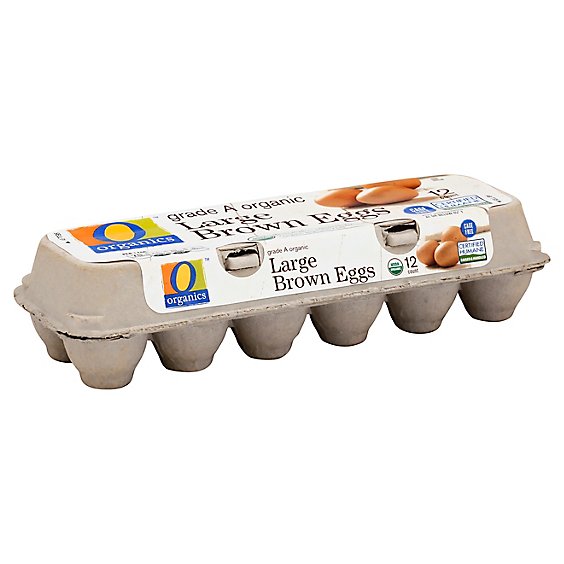
O Organics Organic Eggs Large Brown - 12 Count


O Organics Organic Eggs Large Brown - 12 Count are Grade A organic, cage-free and certified humane raised & handled. They are certified organic by Quality Assurance International, meeting the highest standards for chickens raised without antibiotics and organic vegetarian feed. The eggs have 0g of sugars, only 70 calories and 1.5g of saturated fat per serving. They also meet the Humane Farm Animal Care Program standards to ensure their quality and satisfaction is 100% guaranteed or your money back.
- Organic: Many customers appreciate the organic quality of these eggs, ensuring they are free from pesticides and other harmful chemicals.
- Taste: Reviewers frequently mention the superior taste of these eggs compared to non-organic options.
- Size: The large size of the eggs is often highlighted as a positive feature, providing more value for money.
- Color: The brown color of the eggs is praised by some customers for its aesthetic appeal.
- Freshness: Many reviews highlight the consistently fresh quality of these eggs.
- Humane: Customers appreciate that these eggs are sourced from humanely treated chickens.
- Health Benefits: Some reviewers mention the perceived health benefits of consuming organic products, including these eggs.


