


Yellow, Dijon, Spicy Brown, Whole Grain and Honey Mustard Explained
Mustard seeds come from the mustard plant, a relative of cabbage and broccoli, and people have been grinding them into a condiment for thousands of years. Botanically, mustard belongs to the Brassicaceae family, which also includes horseradish, turnips, and kale. That botanical branch explains a lot about the condiment. The peppery bite you find in fresh turnips or a spoonful of grated horseradish comes from the very same family traits that give mustard its kick.
The Romans mixed crushed seeds with unfermented grape juice, known as must, which is where the name "mustard" comes from. In Latin, this was called mustum ardens, or "burning must." Crushing the seeds into an acidic liquid unlocked a lively heat that became the blueprint for the condiment.
Today most supermarkets carry at least five kinds: yellow, Dijon, spicy brown, whole grain and honey mustard. They sit side by side on grocery shelves, but each one brings its own texture, sweetness, and heat to the table.
To make any of them, the seeds are cracked or ground, soaked in vinegar, water or wine, and blended with salt and spices. Some are heated along the way. Yellow mustard is ground smooth and stays mild, Dijon and spicy brown use hotter brown seed, whole grain keeps the seeds intact, and honey mustard adds sweetness. The seed used determines how hot the mustard can get, and the way it's ground, soaked and heated controls how spicy it tastes.
The Seed Separates Yellow Mustard From Spicy Brown
There are three main kinds of mustard seed: yellow, brown and black. Yellow is the mildest. Brown and black seeds are hotter and more pungent. Each type comes from its own distinct species. Yellow mustard seed comes from Sinapis alba, and brown mustard seed comes from Brassica juncea. Black mustard (Brassica nigra) is rarely grown commercially today because its seed pods shatter easily, which makes it hard to harvest by machine. When black mustard pods ripen, they pop open and drop their seeds before combines can collect them, which makes machine harvesting impractical. Modern commercial agriculture needs crops that can be harvested by machine, so brown mustard seed stepped in to take its place.
The USDA's purchasing specification for prepared mustard calls for yellow seed in yellow mustard, and brown seed in Dijon, honey, stone ground, deli and spicy brown mustard. In that specification, Commercial Item Description A-A-20036D, yellow seed is required for the yellow and jalapeño types, and brown seed for the Dijon, coarse grain Dijon, honey, stone ground, horseradish, deli and spicy brown types. This standard defines exactly what federal buyers expect when purchasing prepared mustards, setting a clear line between mild and spicy varieties.
Yellow mustard gets its bright color from turmeric. Arizona State University describes it as finely ground yellow seed mixed with turmeric, vinegar and water. That pinch of turmeric creates the vivid color you expect on ballpark hot dogs. Some brown mustards also contain turmeric, so you can't tell which seed was used just by looking at the color. A jar with a golden tint might hold hotter brown seeds instead of gentle yellow ones.
The FDA lists turmeric as a color additive exempt from certification under 21 CFR 73.600, and paprika, often added alongside it, under 21 CFR 73.340. These natural colorings give producers a reliable, uniform shade across production runs without artificial dyes.
The ingredient list won't tell you either. Signature SELECT, one of Safeway's own brands, lists "Vinegar, Water, Mustard Seed, Salt, Turmeric, Paprika" on its yellow mustard. Its spicy brown lists "Vinegar, Water, Mustard Seed, Salt, Turmeric."
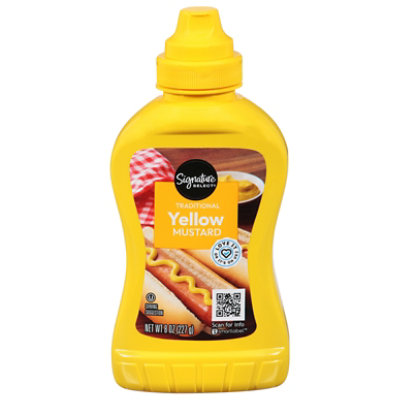
The first five ingredients are the same, and neither label says what kind of seed is inside. Both bottles simply print "Mustard Seed" on the package, with no mention of Sinapis alba or Brassica juncea. You can hold them side by side in the aisle, check the back panels, and find no clue about which species is inside.
The USDA specification fills in the gap. Yellow mustard uses mild yellow seed and is smooth. Spicy brown uses hotter brown seed and is ground more coarsely, which is why you can see specks of seed in it. Those visible specks are bits of dark seed coat that remain after a rough grind. Dijon also uses brown seed, giving it the same underlying heat even though it gets milled into a silky paste.
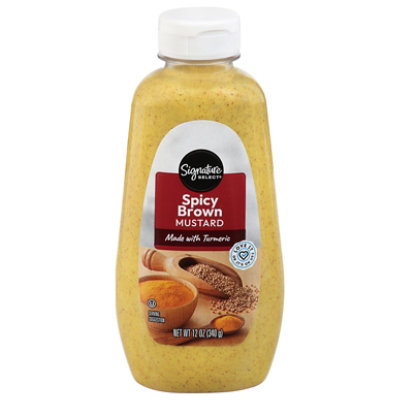
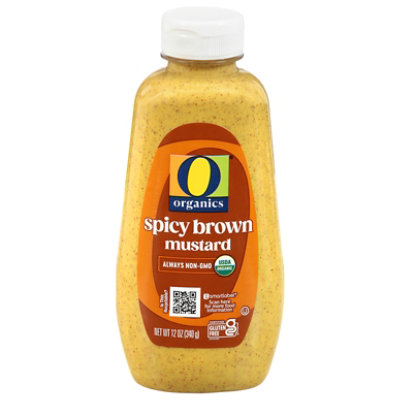
O Organics makes a spicy brown too.
How Mustard Gets Its Heat
A whole, dry mustard seed isn't spicy yet. Chewing on a dry seed yields a nutty bitterness, but no heat. The sharp flavor stays locked away inside dormant cells.
Grinding the seed breaks open its cells, and when liquid is added, an enzyme in the seed reacts with other compounds stored inside it. That reaction produces mustard oil, which is what gives mustard its sharp taste. The McCormick Science Institute says that mixing ground mustard seeds with water sets off a reaction between the enzyme myrosinase and glucosinolate compounds such as sinigrin and sinalbin, which turns them into isothiocyanate compounds. In an intact seed, the myrosinase enzyme and the glucosinolates are stored apart. Crushing the seed and adding liquid lets them mingle, setting off the reaction that builds the pungent oil.
Brown seed contains compounds that produce more heat than those in yellow seed. That's why Dijon and spicy brown taste sharper than yellow mustard, even when the ingredient lists look almost the same. The difference lies in the exact glucosinolate molecules each plant species produces.
Brown seed's main glucosinolate is sinigrin, which yields allyl isothiocyanate, a volatile compound that reaches the nose. Because allyl isothiocyanate is volatile, it evaporates quickly at body temperature and rises into your nasal cavity, creating that sharp, eye-watering rush you feel when you eat spicy brown mustard. Yellow seed's main glucosinolate is sinalbin, which yields p-hydroxybenzyl isothiocyanate, a milder heat. This compound is non-volatile, so it stays on your tongue, producing a steady warmth in your mouth without rushing up into your sinuses.
The liquid matters too. The McCormick Science Institute says, "Compared to cold water, vinegar lessens the heat produced and creates a milder outcome." Mustard mixed with cold water gets hotter, as plain water lets myrosinase work at full speed. Mustard mixed with vinegar or wine stays milder, because acid lowers the pH and reins in the enzyme before it can convert all the glucosinolates into heat.
Heat stops the enzyme from working, so cooking the mustard during production also keeps it milder. Enzymes are sensitive to temperature, and high heat deactivates them entirely. That's how the same few ingredients can make a mild yellow mustard, a sharp Dijon or a coarse spicy brown. In one study of hydrated brown mustard seed, temperatures above about 67°C (153°F) reduced how much sinigrin was converted to allyl isothiocyanate. Passing that 67°C threshold halts the reaction, locking the mustard into a milder profile before the heat peaks.
Mustard also loses its heat over time. Once a jar is open, it slowly gets milder. Keeping it in the fridge, as the label says, helps it hold its flavor longer. Allyl isothiocyanate is volatile and breaks down over time, and cold slows that loss. At warm room temperatures, those delicate flavor compounds break apart faster, leaving the condiment tasting dull. Storing your jar in the refrigerator protects those volatile oils so your mustard keeps its bite.
Dijon Is a Style, Whole Grain Is About the Grind
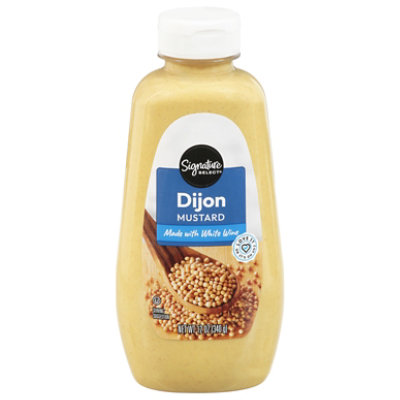
Dijon mustard was first made in Dijon, France, but mustard labeled Dijon doesn't have to come from there anymore. French law requires Dijon mustard to use brown or black seed, but it allows several different liquids, including vinegar, grape juice, grape must and wine. So Dijon doesn't have to contain wine. Signature SELECT Dijon does. Its label lists white wine along with water, mustard seed, vinegar and salt. That splash of white wine gives the spread a dry, subtle acidity that cuts cleanly through rich meats.
In 1856, Jean Naigeon of Dijon replaced the vinegar usually used in mustard with verjuice, the tart juice of unripe grapes, which gave Dijon its smoother style. Verjuice brought a gentler, more rounded acidity than grain vinegar. Over time, white wine and wine vinegars became the standard way to capture that balance.
Today, "Dijon" is a generic style name rather than a protected geographical indication. Any maker anywhere can produce a smooth brown-seed mustard and put Dijon on the label. "Moutarde de Bourgogne," by contrast, is protected in the European Union and must be made with seed grown in Burgundy. That label carries legal protection, requiring certified local seeds and traditional regional processing.
The Signature SELECT coarse ground Dijon and the O Organics honey Dijon don't list wine at all. On a US bottle, "Dijon" tells you to expect the sharper, brown-seed style. To find out what liquid was used, check the ingredients. A quick scan of the back panel tells you whether a jar relies on white wine, distilled vinegar, or fruit juices for its tang.
O Organics also sells a smooth Dijon.
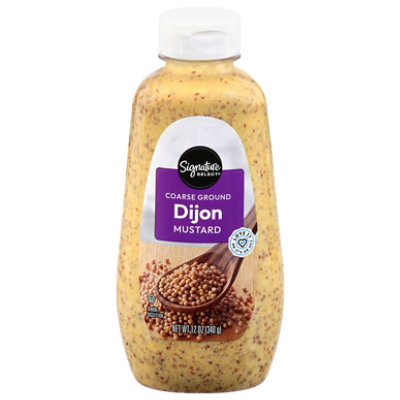
Ingredients Water, Mustard Seed, Vinegar, Salt, Citric Acid, Turmeric.
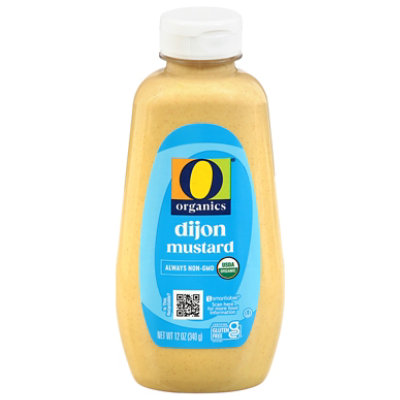
Ingredients Water, Organic Mustard Seeds, Organic Vinegar, Salt, Organic Natural Flavor, Organic Turmeric, Organic Guar Gum, Organic Spices.
Whole grain, coarse ground and stone ground describe how much the seed was crushed. Whole-grain mustard keeps the seeds whole. The soaked seeds plump up in the jar and pop between your teeth as you chew. Coarse-ground and stone-ground mustards have rough, broken pieces of seed, so they look speckled and have more texture than a smooth Dijon. They hold their own on charcuterie boards, alongside sharp cheeses, and inside thick sandwiches.
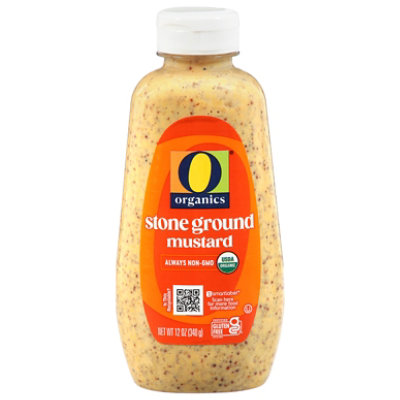
O Organics, another Safeway brand, makes a stone ground mustard with water, organic mustard seeds, organic vinegar, salt and organic spices. It has no wine or turmeric. The simple list highlights the natural, rustic flavor of the crushed seeds.
Signature SELECT's stone ground mustard is blended with horseradish.
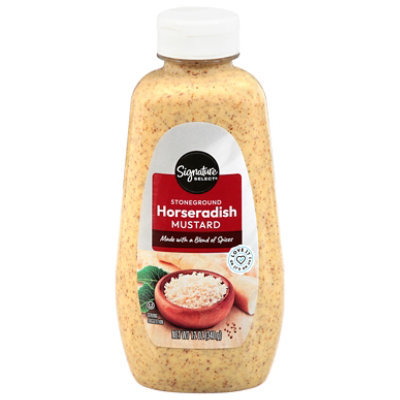
Traditional stone-ground mustard is made by crushing the seeds between millstones. Heavy millstones crack the seed hulls into uneven pieces without pulverizing them into a fine paste.
Mustard also works as an emulsifier in salad dressings, because mucilage from the seed coat helps keep oil and vinegar from separating. The outer layer of the seed contains natural mucilaginous fibers that swell in liquid. Whisking a spoonful of mustard into oil and vinegar coats the oil droplets, keeping them suspended so your vinaigrette stays blended instead of splitting.
Check the Label for Honey, Storage and Gluten
Honey mustard is sweetened, but not always mostly with honey. Shoppers often assume the sweetness comes entirely from the hive, but recipes vary across the shelf.
Signature SELECT honey mustard lists sugar before honey, with brown sugar further down. Ingredients are listed by weight, so that bottle contains more sugar than honey. Granulated sugar provides the main sweetness, while honey and brown sugar add flavor and aroma.
O Organics honey Dijon is sweetened only with organic honey, and it doesn't list wine. It pairs the sharpness of brown mustard seed directly with organic honey, skipping refined sugar altogether. Neither one is better than the other. They're just different recipes. A sugar-forward honey mustard makes an easy, family-friendly dipping sauce for pretzels and chicken nuggets, while a honey-only version offers a more floral profile for dressings and glazes.
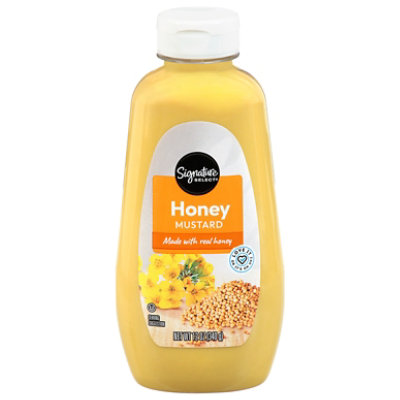
Ingredients Water, Vinegar, Mustard Seed, Sugar, Cider Vinegar, Honey, Brown Sugar, Salt, Spices, Turmeric, Citric Acid, Paprika.
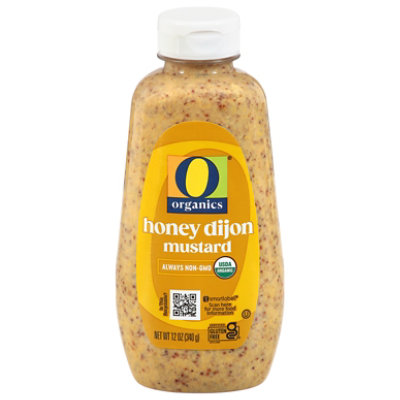
Ingredients Water, Organic Mustard Seeds, Organic Vinegar, Organic Honey, Salt, Organic Guar Gum, Organic Spices.
Every Signature SELECT and O Organics mustard we looked at says to refrigerate after opening. Following that recommendation protects your mustard from losing its character.
The vinegar makes mustard acidic, which helps it last. A Wyoming Department of Health chart based on the FoodKeeper app says opened mustard keeps for one year in the fridge. The same chart lists unopened mustard at one to two years. Commercial mustard is typically around pH 3 to 4, acidic enough that bacteria struggle to grow, but refrigeration helps protect flavor and color. At a low pH between 3 and 4, spoilage organisms cannot easily gain a foothold. An opened bottle will not become unsafe on the counter, but the cold temperature in your refrigerator prevents the condiment from browning and keeps the volatile oils from fading.
Mustard seed is naturally gluten-free, but some brands add flour. All the Safeway brand mustards in this article are certified gluten-free, but not every mustard is, so check the label.
Under FDA regulation 21 CFR 101.91, foods labeled "gluten-free" must contain less than 20 parts per million of gluten. That standard keeps the food safe for anyone with celiac disease or gluten sensitivity.
Gluten can appear in prepared mustards through thickeners or grain vinegars. Some English-style mustards use wheat flour as a thickener, and malt vinegar is made from barley. Since barley contains gluten, any mustard made with malt vinegar will not be gluten-free. Checking the ingredient list or looking for a certified gluten-free symbol on the label keeps you safe.
Common Questions About Mustard Types
What's the difference between Dijon and yellow mustard?
Dijon is made with brown or black seed, which is hotter. Yellow mustard uses mild yellow seed, is smooth, and gets its color from turmeric. Dijon can be made with vinegar, grape juice, grape must or wine. Those liquids give Dijon a more layered, complex flavor, while yellow mustard delivers a bright, straightforward vinegar punch.
Why is Dijon mustard spicy?
Because it uses brown or black seed. When the ground seed is mixed with liquid, it produces mustard oil, and brown and black seeds make a sharper-tasting oil than yellow seed does. Brown seed's glucosinolates release allyl isothiocyanate, a volatile compound that evaporates quickly and travels into your nasal passages, creating a distinctive sinus heat.
Can I use spicy brown instead of Dijon?
Yes, in most cases. Both are made with brown seed, so they have similar heat. Spicy brown is coarser, with visible specks of seed and a slightly vinegary taste. Dijon is smooth, and its flavor depends on which liquid was used. You can substitute them easily on sandwiches and grilled meats, though smooth Dijon blends more seamlessly into creamy vinaigrettes and delicate pan sauces.
Does mustard go bad?
Not quickly. Keep it in the fridge after opening and it should last about a year. Unopened mustard will keep in the pantry for one to two years. Commercial mustard's acidity, typically around pH 3 to 4, makes it difficult for bacteria to grow, but chilling it after opening protects its sharp flavor, aroma, and color over time.
Is mustard gluten-free?
The seed is, but some brands add flour. Look for a gluten-free label on the bottle. Under FDA regulation 21 CFR 101.91, foods labeled gluten-free must contain less than 20 parts per million of gluten. Check the ingredients carefully, as some English-style mustards use wheat flour as a thickener, and malt vinegar is made from barley.
What's the difference between whole grain and stone ground mustard?
Whole-grain mustard keeps the seeds whole. The hydrated seeds remain intact, giving the spread a pleasant pop of texture when you chew. Stone-ground mustard has seeds that have been coarsely crushed between millstones. That process breaks the seeds into rough fragments, creating a thick, textured spread rather than an intact seed mixture.