


Condiments to Refrigerate After Opening and How Long They Keep
Open your refrigerator door, and you will probably find a crowded collection of bottles and jars. Ketchup, mustard, mayonnaise, barbecue sauce, and salad dressings take up permanent residence there. Most carry the familiar phrase "refrigerate after opening" on the label. It looks like an urgent safety warning, but for many everyday staples, the reality is more nuanced.
Many common condiments, such as ketchup, mustard, mayonnaise, and soy sauce, are completely shelf-stable when you buy them. You find them sitting on unrefrigerated grocery shelves for months without issue. As USDA FoodKeeper explains, "quality, not safety, is the reason the labels on these products suggest that they be refrigerated after opening."
Understanding that distinction changes how you view your kitchen. Food safety, as outlined by the USDA Food Safety and Inspection Service (FSIS), involves preventing foodborne illness from pathogenic bacteria like Salmonella, Listeria, or E. coli. High-acid and high-salt condiments are manufactured to prevent these pathogens from multiplying at room temperature. The formula itself acts as a defensive shield.
Food quality refers to the flavor, aroma, texture, and color of the food. When exposed to oxygen, ambient warmth, and light, condiments undergo chemical oxidation that dulls flavor and darkens color. Refrigeration slows these chemical reactions, keeping condiments tasting fresh for months.
This quality focus also applies to commercial package dates. USDA FSIS notes that dates on shelf-stable foods are generally not safety dates. A "Best if Used By" or "Best Before" date indicates when a product will have its peak flavor or quality, and it is not a safety date. A "Use-By" date represents the manufacturer's recommended deadline for peak quality while the product remains unopened. In the United States, commercial food dating is voluntary on shelf-stable foods, with infant formula being the sole exception required by federal regulation.
Once opened, how long a condiment stays good depends on clean handling and proper refrigeration. Using clean utensils, securing caps tightly after each use, and choosing squeeze bottles that minimize air contact help protect quality and prevent cross-contamination.
Why Acid and Salt Help Condiments Keep
Condiments survive on an open grocery shelf before purchase because of chemistry, specifically high acidity and heavy salt. Harmful bacteria need specific conditions to survive and multiply, and acid creates an environment where they struggle to stay alive.
Scientists measure acidity using the pH scale, where lower numbers mean greater acidity. Average pH levels for common condiments are 3.6 for ketchup, 3.1 for mustard and 3.7 for typical mayonnaise, with a lower pH meaning greater acidity. University of Wisconsin-Madison Extension says foods with a pH of 4.6 or below "are considered high in acid." Because all three condiments sit well below that 4.6 threshold, their acidity provides a strong barrier against dangerous microorganisms.
That acid environment actively destroys pathogens rather than merely pausing them. A University of Wisconsin study found that all Salmonella died within 1 hour in mustard stored either cold or at room temperature. In ketchup at room temperature, all Salmonella died within 1 day. While cold temperature seems not to matter for killing those bacteria, refrigeration is still advised because these products maintain their quality better when cold. Chilling locks in bright color and keeps flavors from turning dull or flat.
Salt works differently. USDA's Food Safety and Inspection Service says, "Salt binds or removes water so that it does not enable the growth of microorganisms." The condiment will still retain water, but less of that water is available for microbial growth. Salt draws water out of microbial cells by osmosis. In a high-sodium condiment like soy sauce, so little water is left free that bacteria cannot multiply, though cold storage is still what protects the flavor.
Contamination can cause bacteria growth. Introducing outside germs can overwhelm a condiment's natural barriers. Do not put a meat-basting brush that has come in contact with raw meat back into a bottle, or dip in a knife that was licked clean. University of Wisconsin-Madison Extension states, "While we expect the acidity of condiments to help ensure safety, it could be possible to transfer so many germs to the container that the amount of acid simply was not enough and pathogens survived."
To baste safely, USDA FSIS advises setting aside a portion of sauce before any of it touches raw meat, and boiling used marinade before brushing it onto cooked food. Before you start grilling, pour whatever sauce you need into a separate prep bowl. Keep the main bottle capped in the kitchen so raw meat juices never touch the container. If you need extra glaze near the end of cooking, boil any sauce that touched a raw-meat brush before brushing it onto cooked food.
Wipe dried sauce from the bottle neck with a clean paper towel as well; crust there can mold even when the sauce inside is acidic. That crusted buildup around the rim sits exposed to air, moisture, and dust, giving mold spores a foothold even while the liquid inside the bottle stays safe.
How Long Opened Condiments Keep
These are the USDA FoodKeeper pantry-from-purchase and refrigerated-after-opening times for shelf-stable commercial products.
Condiment | Pantry from purchase | Refrigerated after opening |
|---|---|---|
Ketchup | 1 year | 6 months |
Mustard | 1 to 2 years | 1 year |
Commercial mayonnaise | 3 to 6 months | 2 months |
Soy sauce | 3 years | 1 month |
Hot sauce | 6 months | No figure given |
Bottled barbecue sauce | 1 year | 4 months |
Bottled commercial salad dressing | 10 to 12 months | 1 to 3 months |
Hot sauce has no after-opening refrigerator figure in the USDA data. FoodKeeper says it "Will stay fresher longer if refrigerated," while Frank's says refrigeration "is not necessary if you prefer" the sauce at room temperature, though chilling helps maintain its flavor. Left at room temperature, hot sauce gradually oxidizes, shifting from bright red to a dull brownish color over time.
Ketchup keeps for 6 months after opening in the refrigerator. In an unopened state, it stays good in your pantry for 1 year from the date of purchase. Signature SELECT, Safeway's own brand, prints "Refrigerate after opening" on its bottle.
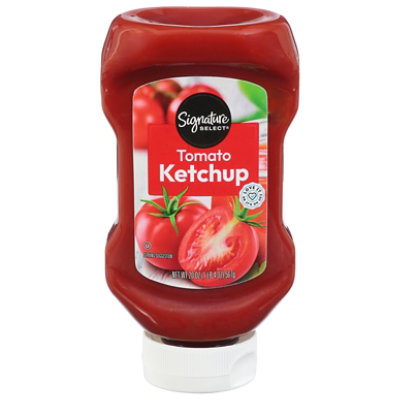
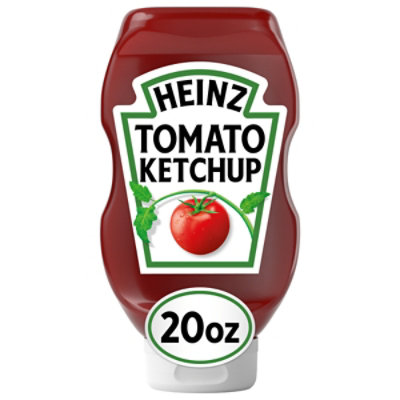
Similarly, Heinz states, "For best results, shake well before first use and refrigerate after opening." Heinz notes that ketchup is shelf-stable because of its natural acidity. Chilling preserves its fresh flavor, while an opened bottle left on the counter oxidizes and darkens much faster.
Mustard has the longest refrigerator time in the table at 1 year. Before opening, it can sit safely in your pantry for 1 to 2 years from purchase. The Signature SELECT Traditional Yellow Mustard label says, "Shake well before serving. Refrigerate after opening."
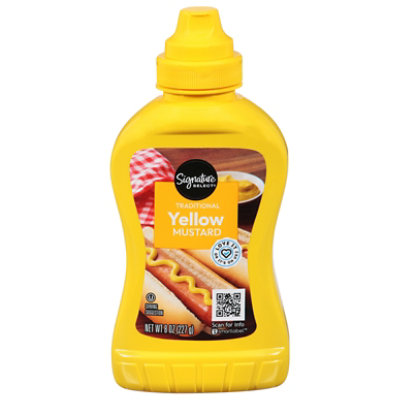
Ingredients Vinegar, Water, Mustard Seed, Salt, Turmeric, Paprika.
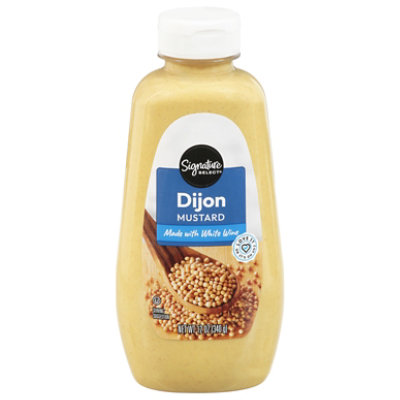
Ingredients Water, Mustard Seed, Vinegar, Salt, White Wine, Citric Acid, Turmeric, Tartaric Acid, Spices.
French's says there are no ingredients in mustard that spoil and to refrigerate after opening "for best flavor"; left out, mustard mainly dries out and loses its pungency. Chilling protects the volatile oils that give mustard seeds their sharp bite.
Regular soy sauce keeps its best quality for 1 month after opening in the refrigerator, though it lasts up to 3 years in the pantry before opening. Kikkoman says unrefrigerated soy sauce "would not spoil" as long as no water or other ingredients have been added, but freshness and flavor will change after opening. Its bottle says, "Refrigerate after opening for quality." Kikkoman notes that contact with oxygen turns the sauce darker, and that cold storage prevents that oxidation so the full flavor lasts.
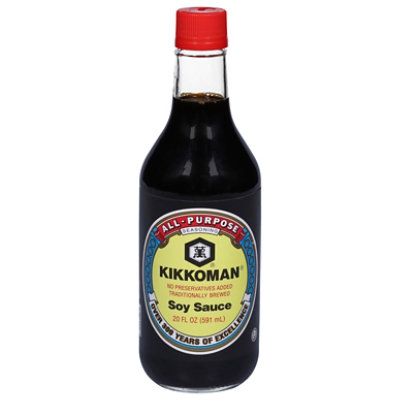
Hot-sauce labels vary across brands, with Signature SELECT Louisiana Hot Sauce suggesting to "keep refrigerated after opening," while the Safeway pages for Frank's RedHot and Tabasco carry no refrigeration line.
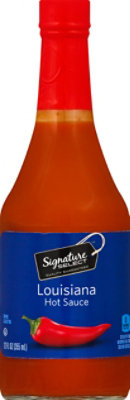
McIlhenny Company, maker of Tabasco brand pepper sauce, lists only distilled vinegar, red pepper, and salt, and says refrigeration is not required, though the sauce keeps its red color longer when chilled. If you use hot sauce daily, keeping it on the counter works fine. If a bottle lasts you months, keeping it cold preserves that vibrant color and crisp pepper aroma.
Bottled barbecue sauce keeps for 1 year in the pantry from purchase and 4 months in the refrigerator after opening, according to USDA FoodKeeper. Barbecue sauces contain tomato paste, vinegar, salt, and generous amounts of sugars like molasses, brown sugar, or corn syrup. Kraft Heinz prints "Refrigerate After Opening" on its barbecue sauces. In a warm pantry after opening, the high sugar content can eventually foster mold or wild yeast growth once exposed to airborne spores. Signs that barbecue sauce has deteriorated include noticeable darkening from reddish-brown to near black, gas accumulation that causes the bottle to pop or hiss when opened, a fermented sour odor, or visible mold on the surface or lid. USDA FSIS says mold threads run deep into soft, moist foods, so a sauce that shows mold should be discarded.
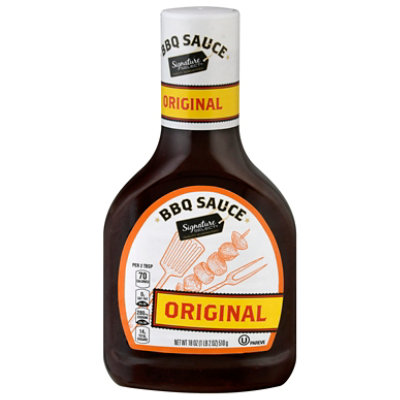
Bottled commercial salad dressings keep for 10 to 12 months in the pantry from purchase and 1 to 3 months in the refrigerator after opening, based on USDA FoodKeeper data. The shelf life within that window depends on whether the dressing is vinegar-based or dairy- and egg-based. Oil-and-vinegar dressings, such as Italian dressing and vinaigrettes, are high in acid, which inhibits bacteria and puts them at the longer end of that window. Creamy dressings like ranch, blue cheese, Thousand Island, and Caesar contain buttermilk, sour cream, cheese, or egg yolks. They are commercially acidified and pasteurized for safety, but their dairy fats and vegetable oils oxidize and turn rancid sooner, which is why they sit at the shorter end. Shelf-stable creamy dressings say to refrigerate after opening; follow the label. Signs of spoiled salad dressing include an unblendable separation, curdling, a rancid odor, or mold. If mold or rancidity appears, discard the entire bottle.
The Signature SELECT Italian dressing is the vinegar-based kind and the ranch is the creamy kind, so the two sit at opposite ends of that window.
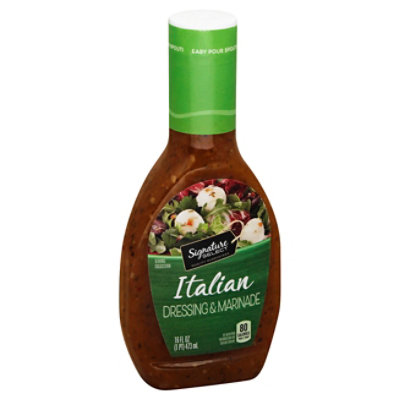
Ingredients Water, Vegetable Oil (Soybean Oil and/or Canola Oil), Sugar, Distilled Vinegar, Salt, Less than 2% of: Dried Onion, Dried Garlic, Dried Red Bell Peppers, Spices, Xanthan Gum, Yeast Extract, Oleoresin Paprika (Color), Lemon Juice Concentrate, Calcium Disodium EDTA (Preservative), Annatto Extract (Color).
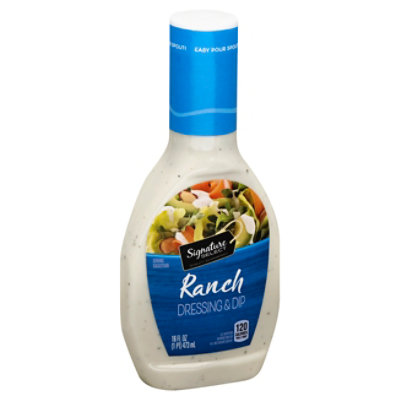
Ingredients Vegetable Oil (Soybean Oil and/or Canola Oil), Water, Lowfat Buttermilk (Cultured Pasteurized Part-Skim Milk, Nonfat Milk Powder, Salt), Sugar, Egg Yolks, Less than 2% of: Salt, Modified Food Starch, Natural Flavor, Distilled Vinegar, Phosphoric Acid, Lactic Acid, Dried Garlic, Dried Onion, Buttermilk, Monosodium Glutamate, Titanium Dioxide (Color), Disodium Phosphate, Xanthan Gum, Spices, Yeast Extract, Disodium Inosinate and Disodium Guanylate, Potassium Sorbate, Sodium Benzoate and Calcium Disodium EDTA (Preservatives).
Other condiments in the table follow similar patterns between refrigeration and quality. Where you store condiments in the refrigerator also matters. USDA FSIS says not to keep perishable foods in the refrigerator door, because its temperature swings more than the cabinet's each time the door opens. Door bins take the brunt of warm kitchen air every time you open the fridge. High-acid, high-salt items like ketchup, mustard, and vinegar-based hot sauces tolerate the door without issue. Opened mayonnaise and creamy dressings are better on an interior shelf, where the temperature stays steadily at or below 40°F.
Freezing is not recommended for opened condiments. USDA FSIS says food kept at 0°F stays safe indefinitely, only quality suffers, and that emulsions such as mayonnaise separate and look curdled after freezing, so commercial mayonnaise should not be frozen. Thawed ketchup and mustard tend to weep liquid, leaving watery pools and separated solids, so there is little point freezing an opened bottle.
Kansas State University Extension suggests writing the opening date on each container with a permanent marker and checking it against USDA FoodKeeper times. Keep a marker in your kitchen drawer. When you open a bottle of barbecue sauce, jot the date on the cap so you know when the 4 months began. A simple routine every few months keeps your refrigerator organized: wipe crusted sauce from caps and rims with a clean towel, and discard anything with an off odor, abnormal separation, or visible mold.
Mayonnaise Has Its Own Time Limit
Commercial mayonnaise belongs in the refrigerator after opening. Its USDA FoodKeeper refrigerator time is 2 months, compared to 3 to 6 months in the pantry before opening. Shelf-stable commercial mayonnaise is safe at room temperature after opening, with refrigeration recommended for quality. Hellmann's suggests refrigerating immediately and to use opened mayonnaise within 2 to 3 months, ensuring not to leave it out for longer than 4 hours. What ends an opened jar's quality is the oil turning rancid as it oxidizes, not bacteria. Mayonnaise contains a high concentration of vegetable oils. When those fats interact with air and warm room temperatures, their chemical bonds break down, producing unpalatable off-flavors. An interior shelf gives it the steady cold that slows that degradation.
That 4-hour direction applies to the mayonnaise itself sitting on your kitchen counter during meal preparation. Once mayonnaise is mixed with potatoes, chicken, pasta or eggs, the whole dish is perishable. USDA's Food Safety and Inspection Service says, "Never leave food out of refrigeration for over 2 hours." When the temperature is above 90°F, USDA FSIS reduces this limit to 1 hour, as the low-acid ingredients let bacteria multiply quickly if the dish is not kept on ice.
A bowl of chicken or potato salad at a summer picnic demonstrates why that rule matters. Commercial mayonnaise carries enough acidity to resist bacteria, but potatoes, chicken, pasta, and eggs are low-acid foods. Mixing them together dilutes that acid protection. When temperatures climb above 90°F, bacteria can multiply quickly in those low-acid ingredients if left out over 1 hour. Keeping picnic salads in an insulated cooler nested over ice protects everyone at the table.
Commercial mayonnaise is acidified and made with pasteurized eggs. NC State University says it is acidified "to reduce spoilage and kill off human pathogens," while North Dakota State University Extension explains that its acid and salt kill and slow bacteria. When left outside, such as at a picnic, the low-acid foods mixed into mayonnaise and time spent outside of the refrigerator can cause concern.
Homemade mayonnaise does not have the same storage time as store-bought products. USDA FoodKeeper gives homemade aioli 3 to 4 days in the refrigerator, compared to 2 months for opened commercial mayonnaise, while University of Wisconsin-Madison Extension warns that homemade mayonnaise often contains raw eggs and should be refrigerated. Clemson Cooperative Extension notes that commercial mayonnaise and dressings are made with pasteurized eggs, while homemade mayonnaise made from raw eggs carries a Salmonella risk. Commercial producers use heat pasteurization to destroy pathogens before blending, an extra safeguard home cooks cannot easily replicate when whisking raw eggs by hand.
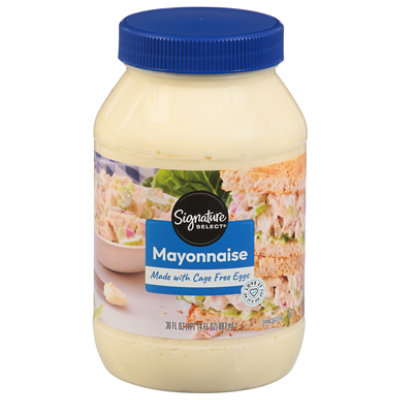
Signature SELECT Mayonnaise, from Safeway's own brand, says, "Refrigerate after opening. Do not freeze." The instruction to avoid freezing stems from mayonnaise's structure as an oil-in-water emulsion. USDA FSIS notes that freezing makes emulsions like mayonnaise separate and look curdled once thawed. Ice crystals puncture the suspended oil droplets, causing the oil and water to separate permanently.
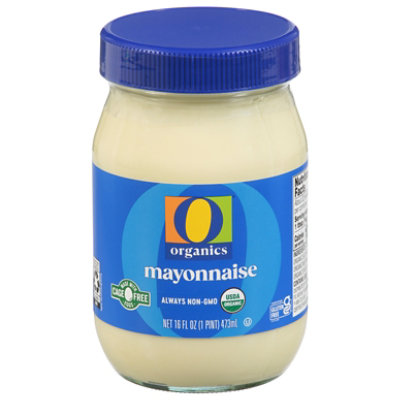
O Organics is also Safeway's own brand. Its Organic Mayonnaise label reads, "For Best Quality: Store in cool, dry place. Refrigerate after opening."
Handling mayonnaise with clean utensils is critical to prevent spoilage. Dipping a used knife into the jar introduces moisture, crumbs, and bacteria that degrade the product. For this reason, squeeze bottles offer an advantage by dispensing mayonnaise without utensil contact. Signs that mayonnaise has gone bad include noticeable oil separation that cannot be stirred back in, a darkened yellowish surface, a pungent sour or rancid odor, or mold growth. USDA FSIS says mold threads run deep into soft, moist foods, so a jar with visible mold should be discarded, not scraped.
Common Questions About Condiment Storage
Does ketchup need to be refrigerated after opening?
Refrigerating opened ketchup preserves its quality, though shelf-stable commercial ketchup stays safe at room temperature. It keeps for 6 months under refrigeration. Heinz notes that ketchup is shelf-stable because of its natural acidity and that refrigerating after opening is "for best results": it remains safe on the counter, but flavor and color fade faster without cold storage.
How long can mayonnaise sit out?
Hellmann's says no longer than 4 hours for mayonnaise itself, recommending you refrigerate the opened jar immediately. Once mayonnaise is mixed into a perishable dish with potatoes, chicken, pasta, or eggs, USDA FSIS sets a 2-hour limit outside refrigeration. When the temperature rises above 90°F, USDA FSIS reduces that limit to 1 hour.
Does soy sauce go bad if not refrigerated?
Kikkoman says regular soy sauce "would not spoil" without refrigeration if no water or other ingredients were added. For the best quality, refrigerate it and use it within 1 month of opening. Kikkoman notes that contact with oxygen turns the sauce darker, and that cold storage prevents that oxidation so the full flavor lasts.
Does hot sauce need to be refrigerated?
USDA FoodKeeper gives no refrigerator time for hot sauce after opening, but notes that it "Will stay fresher longer if refrigerated." Frank's says chilling "is not necessary if you prefer" room temperature, though it helps maintain flavor. McIlhenny Company says refrigeration is not required for Tabasco, though the sauce keeps its color longer when chilled. When another maker directs you to refrigerate, follow the label.
How long does mustard last in the fridge?
USDA FoodKeeper gives opened mustard 1 year in the refrigerator, compared to 1 to 2 years in the pantry before opening. French's says nothing in mustard spoils and recommends refrigeration after opening "for best flavor"; left at room temperature, it gradually loses its pungency and dries out.
Is store-bought mayonnaise safer than homemade?
Commercial mayonnaise is acidified to reduce spoilage and contains pasteurized eggs. Clemson Cooperative Extension notes that commercial mayonnaise and dressings are made with pasteurized eggs, while homemade mayonnaise made from raw eggs carries a Salmonella risk. USDA FoodKeeper gives homemade aioli 3 to 4 days in the refrigerator, compared to 2 months for opened commercial mayonnaise.
What is the difference between "Best if Used By" and "Use-By" dates?
USDA FSIS explains that a "Best if Used By" date indicates when a product will have peak flavor or quality, and is not a safety date. A "Use-By" date represents the manufacturer's recommended deadline for peak quality while the product remains unopened. Except on infant formula, commercial product dating in the United States is voluntary and reflects quality rather than safety.
How long does barbecue sauce last after opening?
USDA FoodKeeper states that opened barbecue sauce lasts 4 months in the refrigerator, compared to 1 year in the pantry before opening. Kraft Heinz labels its barbecue sauces "Refrigerate After Opening." If the sauce develops a fermented sour odor, bubbles with gas that makes the bottle pop, or grows visible mold, discard it immediately.
How should opened salad dressings be stored?
USDA FoodKeeper gives opened commercial salad dressings 1 to 3 months in the refrigerator. Vinegar-based dressings sit at the longer end of that window because of their acidity. Creamy dressings made with dairy or egg fats oxidize sooner and sit at the shorter end. Shelf-stable creamy dressings say to refrigerate after opening; follow the label.
Should condiments be stored on the refrigerator door or the interior shelves?
USDA FSIS says the door's temperature swings more than the cabinet's each time the door opens, advising against storing perishables there. High-acid, high-salt items like ketchup, mustard, and hot sauce tolerate the door bins. Opened mayonnaise and creamy dressings are better placed on an interior shelf where the temperature stays steadily at or below 40°F.
How can you tell if a condiment has gone bad?
Common signs of spoilage include visible mold, unblendable separation, a sour or fermented smell, and severe darkening. USDA FSIS says mold threads run deep into soft, moist foods, so discard a condiment that shows mold rather than scraping it. If a sauce smells yeasty, sour, or rancid, it should be discarded.