


Cereal Box Dates, Staleness and Sogginess
The date printed on cereal boxes helps you judge when the cereal has its best flavor and texture. Cereal past the date impacts the quality of it. Because ready-to-eat breakfast cereal is a shelf-stable dry grain product, passing this calendar threshold does not make it hazardous or unsafe to consume. Over time, the grain gradually loses its toasted flavor, signature crispness, and fresh aroma.
Finding a box in your pantry past its stamped date does not mean you must discard it. Ready-to-eat cereal is dried until almost no moisture remains. Because bacteria need water to grow, dry grains on a pantry shelf do not spoil like perishable groceries. The printed date marks quality, not food safety.
USDA explains that a “'Best if Used By (or Before)' date is recommended for best flavor or quality. It is not a purchase or safety date.” The USDA Food Safety and Inspection Service (FSIS) recommends that manufacturers and retailers who date their products use the phrase "Best if Used By," and the Food Marketing Institute and the Consumer Brands Association (formerly the Grocery Manufacturers Association) have backed the same wording to reduce consumer confusion.
These words matter. A "Best if Used By" date, a "Sell-By" date, and a packing code do not all mean the same thing.
Moisture takes away cereal's crunch because air contains water, and dry cereal pulls that water from the air. Because the cereal is so dry, it takes up water readily from humid kitchen air. Once air gets through the box liner, the cereal starts to get damp, which means it loses its crunch.
Can cereal expire?
Read the words beside the printed mark first, as food packages in the United States do not use one standard dating system. USDA says:
"There is no uniform or universally accepted system used for food dating in the United States."
Federal regulations also do not generally require product dating, except for infant formula, so a printed date does not always mean the same thing. The label tells you how to read them.
"Best if Used By" refers to the cereal's best flavor or quality. It does not set a purchase deadline or a safety date. FSIS says packaged foods such as cereal are safe past the "best by" date if the package is intact, although they may eventually become stale or develop an off flavor. An intact box past that date remains safe to eat, even if the crispness has softened.
A "Sell-By" date is used by the store: it is a stock-rotation tool for the grocer, not a deadline for eating the cereal at home. USDA puts it this way:
"A 'Sell-By' date tells the store how long to display the product for sale. You should buy the product before the date expires."
Grocery staff use this date to rotate shelves. Purchasing a box near its "Sell-By" date still leaves plenty of time to enjoy it at home.
A "Use-By" date describes peak quality:
"A 'Use-By' date is the last date recommended for the use of the product while at peak quality. The date has been determined by the manufacturer of the product."
Even when a cereal carries a "Use-By" date, it does not become unsafe the moment that date passes. FSIS says a "Use-By" date is not a safety date, except when it appears on infant formula. The agency also points out that shelf-stable foods are sometimes called non-perishable, but no food is truly non-perishable, because all foods begin to lose quality at some rate once they are processed.
Some strings of letters or numbers are not dates for shoppers; they are packing codes used by the manufacturer. USDA defines them as:
"**'Closed or coded dates'* are packing numbers for use by the manufacturer."*
These codes can appear on cereal boxes, and USDA explains where open dates and closed codes often appear:
"Open dating is found primarily on perishable foods such as meat, poultry, eggs and dairy products. 'Closed' or 'coded' dating might appear on shelf-stable products such as cans and boxes of food."
Identify a stamped mark before treating it as a date. Look for "Best if Used By," "Sell-By," or "Use-By." Without those words, the mark may be a packing code, which does not tell you when the cereal should be eaten by. A date and a packing code give you different information. If the box has a stamped mark without any of those words, the manufacturer's own consumer line can tell you what the code means.
When checking an unopened box in your pantry, inspect the carton carefully. Verify that the outer cardboard is intact, without crushed corners, tears, punctures, or water stains. Check the factory glue line across the top flaps to make sure the box was not forced open, allowing outside air or pests to reach the inner bag.
Nutrient levels also shift gradually over prolonged storage. Many ready-to-eat cereals are fortified with vitamins and minerals such as iron, thiamin, riboflavin, niacin, and folic acid under the U.S. Food and Drug Administration's (FDA) voluntary fortification policy. Some vitamins, such as vitamin C and certain B vitamins, can slowly degrade over long storage, which affects nutritional quality rather than safety.
Grain composition also determines how cereal ages. While refined grains contain minimal fat, whole-grain cereals and those with added nuts or seeds retain natural plant oils in the grain germ and bran. Over time, exposure to oxygen causes lipid oxidation, commonly known as rancidity. Rancid fats give cereal a stale, paint-like smell and a bitter taste.
You also check the cereal by inspecting and smelling it. If you try it, notice the flavor, since USDA advises against using food that has developed an off odor, flavor, or appearance, for quality reasons. If cereal smells sharp and paint-like or tastes sour, discard it.
Why does cereal go stale or get soggy?
Cereal stays crisp because it is dry, but air reaches it when the liner is opened, allowing the cereal to pull in moisture and become damp. Its crisp texture fades and leads to staleness. The cellular starch structure that gives cereal its crunch fractures cleanly when dry, but absorbed water molecules make those walls flexible, turning crisp flakes chewy and dull.
When cereal bakes, escaping steam leaves behind microscopic pockets of rigid starch that fracture cleanly under your teeth. Moisture softens those walls, turning crisp flakes chewy and dull.
The liner separates the cereal from room air, but once you tear it open, that barrier is broken. Even a fold leaves a path for air. Cereal box liners are commonly made from plastic film or wax-coated paper, which keep humidity out only while the liner stays sealed.
Milk brings moisture straight to the cereal. In the bowl, it moves into the dry pieces, causing the cereal’s firm and crisp texture to soften as they get wet. This is the same basic change as staling, but the moisture comes from the milk instead of the air. How quickly this happens depends on the shape, density, and porosity of the cereal piece.
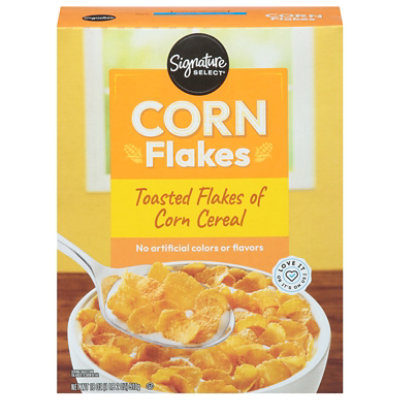
Safeway’s own brand ‘Signature SELECT’ has Cereal Corn Flakes that are made of flakes pressed thin and flat, so each piece has a broad surface and very little thickness.
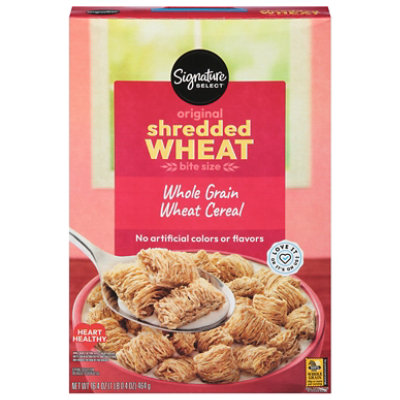
Signature SELECT Cereal Shredded Wheat Bite-Sized has strands of shredded wheat that are packed together into a small, dense biscuit, with pieces able to be eaten in a bite.
Signature SELECT Cereal Crispy Rice is puffed, and each piece is mostly air inside a thin shell.

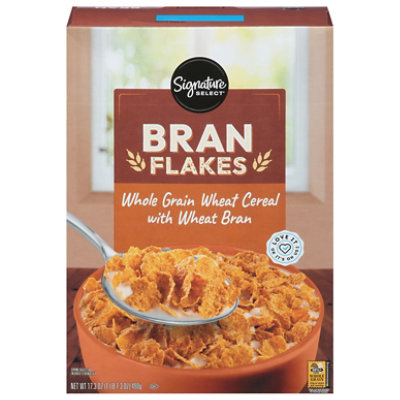
Signature SELECT Cereal Bran Flakes is made with the outer layer of the grain, and that bran is formed into flat flakes.
Toasted oat rings and raisin bran give you two more textures to compare on the same shelf.


These physical shapes determine how milk interacts with each bite. Thin, flat corn flakes and bran flakes present broad surfaces with minimal thickness, allowing milk to saturate the starch walls rapidly. Puffed crispy rice contains large air cavities encased in a fragile outer shell, so milk floods the hollow centers quickly. By contrast, shredded wheat biscuits compress dense, woven grain threads into a compact form, requiring liquid to work slowly through each outer layer before reaching the center.
How should you store cereal after opening?
Close the inner liner each time you use the cereal, ensuring to press out extra air, fold the top down firmly, and secure it so the opening cannot fall loose inside the box. You can also move the cereal to an airtight container, which limits its contact with room air. A rigid container with a gasket lid seals better than a folded bag.
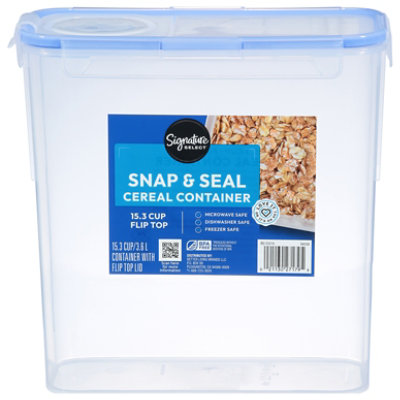
Signature SELECT sells a flip-top airtight container sized for a full box.
Rolling the bag loosely leaves gaps where air enters. Instead, press the liner flat to push out trapped air, fold the top down tightly, and clip it shut. Moving cereal to a rigid container with a rubber or silicone gasket provides an even tighter seal against humidity.
Keep cereal in a cool, dry part of the pantry, away from the stove and other places where heat or moisture can reach the package. Do not leave the liner open while the box sits on the shelf. Stoves and dishwashers give off heat and steam, which can raise humidity in nearby cabinets, so a shelf farther from them is a better spot.
The printed date cannot tell you how long an open box will stay crisp. The seal controls how much room air reaches the cereal, so a firm seal keeps dry cereal away from moisture in the air. An unopened box can sit in a dry cupboard past its printed date and pour out crisp, while an open bag left unsealed during a humid summer week will soften quickly.
Pantry storage also requires protection from stored-product pests. University extension services, such as Michigan State University Extension and UC IPM, note that breakfast cereals are common targets for pantry pests such as Indianmeal moths and sawtoothed grain beetles, which usually enter the home in an infested package. They advise discarding infested food, sealing dry food tightly, and cleaning storage areas thoroughly. Check opened cereal for silken webbing or small larvae, and check other opened boxes of cereal, flour, and noodles at the same time.
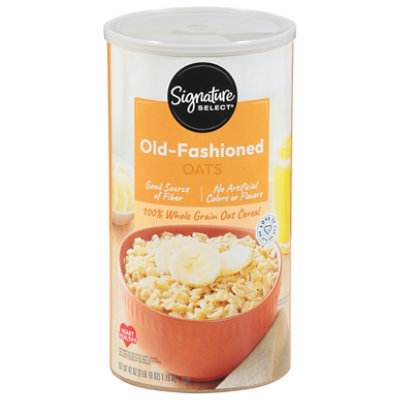
Oats are another major dry breakfast grain, and keeping them dry protects their quality too. The form you buy changes how you prepare them, which is why it helps to see how steel-cut, rolled, and instant oats differ. Like cold cereal, oats keep their quality best when stored tightly sealed in a cool, dry place.
If you will be away from home for a while, do not leave partly used boxes loosely folded in the cupboard. Move the opened cereal to an airtight container or a freezer bag with the air pressed out, or keep it in the freezer until you return. The freezer locks out humid room air and keeps whole grains from developing off flavors while you are away.
What should you do with stale cereal?
Staleness means the cereal has lost quality, so if it has only softened you can still eat it, though it will not have its original texture. If cereal has only taken on moisture from the air and smells fine, you can re-crisp it in the oven. Spread it in an even layer on a baking sheet, warm it in a low oven for a few minutes, and let it cool completely before serving.
You can also repurpose stale cereal in home baking and cooking. Crushed corn flakes and bran flakes make an effective crunchy breading for baked chicken or fish, as well as a topping for casseroles. Softened flakes can also be stirred into muffin batter or cookie dough.
Do not eat cereal with an off odor, flavor, or appearance. USDA says food with these characteristics should not be used for quality reasons. Re-crisping and baking tips apply only to cereal that is slightly stale from clean air moisture; never consume or cook with cereal that smells rancid, shows mold, or exhibits signs of insect pests.
Common questions about stale and expired cereal
Can you eat expired cereal?
Yes. A date on cereal concerns quality, while a stamped code may be a manufacturer packing number. Check whether the cereal smells, tastes, or looks normal. A "Best if Used By" date is not a safety date, so cereal remains safe to eat. Do not use cereal that develops an off odor, flavor, or appearance. FSIS notes that shelf-stable foods are safe past the "best by" date if intact, though quality declines over time.
Can cereal go bad?
Cereal can lose its crunch, develop poor flavor, or change in odor, taste, and appearance, in which case it should not be eaten. Quality loss typically comes from moisture absorption, insect contamination, or rancid fats in whole-grain cereals.
What does the date on a cereal box mean?
"Best if Used By" and "Use-By" dates concern quality, while a "Sell-By" date tells a store how long to display a product. A closed or coded mark is a manufacturer's packing number. The Food Marketing Institute and Consumer Brands Association support "Best if Used By" to reduce confusion.
How do you store cereal so it stays fresh?
Seal the inner liner firmly or move the cereal to an airtight container, and choose a cool, dry pantry spot away from the stove.
Why does cereal get soggy in milk?
Dry cereal softens as it takes on moisture from the milk, so its crunch lasts only for a while.
Can cereal mold?
If cereal shows mold or an altered appearance, do not use it, since USDA treats an altered appearance as a reason not to use food for quality reasons. Mold is unlikely in dry cereal, but it can form if the cereal gets wet.
How long does an unopened box of cereal stay fresh past its date?
Often for a good while, since the date is a quality guide rather than a safety date. USDA's FoodKeeper guidance gives roughly 6 to 12 months of best quality for unopened cereal in the pantry, and flavor and crispness gradually decline after that.
How can you tell if cereal has gone rancid?
Rancidity occurs when natural oils in whole-grain or nut-containing cereals oxidize from air exposure. Rancid cereal smells stale or paint-like and tastes bitter. Whole-grain cereals and those with nuts or seeds are the most likely to turn, because they keep the natural oils of the grain. If you notice these signs, discard the box.
What causes bugs in cereal and how do you inspect for them?
Pantry pests such as Indianmeal moths usually enter the home in an infested food package. Check opened cereal for webbing or tiny larvae, and discard any infested box. Tightly sealing dry food and cleaning shelves helps keep the pests from returning.
Does cereal lose its vitamins over time?
Possibly. Some vitamins in fortified cereal, such as vitamin C and certain B vitamins, can slowly degrade over long storage, which affects nutritional quality rather than safety.
Can you freeze cereal to extend its shelf life?
Yes. Opened cereal can go in an airtight freezer bag or container in the freezer, which keeps room air and humidity away from it.